Showing posts with label Adventure. Show all posts

Sunday, December 23, 2012

BIG BAD BUS


Walking around Johannesburg today I saw this mean-looking vehicle parked at a bus stop. Walking past I was very curious as to what it was. Then I saw a lady go to the counter, pay for something, then get off. I wanted to ask what the vehicle was, but felt intimated because it looked so menacing. After deliberating for a few moments, I doubled back and climbed aboard.
Through the metal bars and thick Perspex screen I asked the driver what the bus was for. He mumbled something incomprehensible. I asked him to repeat it and he mumbled, again incomprehensively, but this time in a very unfriendly tone. A black man in a dirty chef's uniform climbed aboard and asked me "Howzit?" (the local greeting). He seemed infinitely more approachable so I asked him about the bus’ purpose.
I learned that this vehicle is for people to top up their bus cards, which they use on the orange, public buses here. My new friend, the chef, wasn't sure why they used this system, but suggested it was for the safety of the bus drivers. My guess is that because these orange buses go into some very poor and dangerous areas (the townships) it's best to not have cash aboard. All the cash must be kept in these armored vehicles which are less likely to be held up. Though the chef told me these armoured buses get robbed frequently and that would explain the driver’s gruffness.
The chef and I spoke for a while. He works in the apartment complex adjacent to the bus stop. I told him that my brother is a chef, though probably not as good as him. The chef asked me if I knew Soweto. I said I did. It's the township that I visited at the start of my trip. Chef is from Soweto. He asked me about my country and the type of housing there. He didn't know where Ireland was, but I drew a map on the bus' greasy wall. He asked if everyone was rich and I told him no, but he didn’t seem to believe me.

Sunday, November 13, 2011

THE USS LIBERTY

I did two scuba dives in northeast Bali at a place called Tulamben. There is an American shipwreck there. It was an army transport ship that was torpedoed by a Japanese submarine in 1942 and now lies just 40 meters from the beach about 20 meters under water.
It was a spectacular dive, but unfortunately I don't have an underwater camera. However I made before and after videos.
The highlight of the dives was the huge school of jackfish, about 400 in number, swimming in a bright silver spiral next to the wreck. About 15 meters high, this huge living tornado was magnificent to see. Continuously circling together like in Finding Nemo and totally unafraid of us divers. My Dutch diving buddy and I even swam down under the school, turned on to our backs and looked up through them. Amazing! Literally tons of these big fish swimming right over and around us as we gazed up at the surface 20 meters away where the sunlight refracted as it hit the water. A very memorable experience.
The company I dove with was called Adventure Divers. It's run by and English-Dutch gentleman called Ian and I was very happy with their service and equipment. I've included one of their videos that show the wreck dive if you are interested. And you can see the silver jackfish I mentioned at the start of the vid.

Before


After


Adventure Divers Video

Tuesday, October 25, 2011

RINJANI MOUNTAIN, LOMBOK

I just spent a month in Indonesia. Well, actually just the islands of Lombok, Gili and Bali. It was my first time properly backpacking in three years. Little brother Ronan flew over for a couple of weeks and my mate Karol came for three.

The highlight of our trip was a three day hike to the summit of Rinjani Mountain. Rinjani, on the island of Lombok, is Indonesia’s second largest mountain and said to be the most beautiful in the country. It also happens to be an active volcano. But the last eruption was over a year ago, so things were pretty safe. The hike is notoriously difficult with reports of lots of people crying, puking and quitting. So of course, this is just the kind of “holiday” that calls out to me. The summit is just over 3700 meters and the volcano has a crater-lake on top as well as natural hot-springs. It’s a three-day hike with the goal being to reach the summit for sunrise on day three (which requires a 2:30am start).

I felt pretty confident about the hike to be honest because I’ve done longer and higher hikes before. But my confidence quickly dissipated after receiving a link to a tripadvisor page from Ronan. Reading the experiences/complaints of the other hikers, I reassessed the situation. I spent August hiking every weekend to get in decent shape, even hiking up to three times a week when possible. Unfortunately, most of the mountains around me in Seoul are about 600 or 700 meters high, so it certainly wasn’t perfect preparation.

The holiday plan was for us to climb the mountain as early into the trip as possible before the hedonism took tole on our bodies. But it took a couple of days to get orientated and travel from Kuta Bali, our meeting point, to Rinjani by public transport. And by the time we were ready to go, there was already a considerable dent in our four litres of duty-free Jameson whisky.

We intentionally didn’t book in advance as I’d learned from past experience that we could get it much cheaper if we haggled on arrival. It worked out perfectly well. We paid only 700,000 Indonesian Rupiah each. Much cheaper than anyone we met and half of the 1,400,000 the guidebook cited as the going rate.

Our group consisted of us three, four Germans, our guide and five porters. Everyone was real cool. The Germans were all university students and surprisingly well-traveled and worldly. The porters were nice, hardworking and friendly. And the guide, seemingly a teenager, was a cool kid, but appeared to be in the worst shape of the whole group. Perhaps due to his incessant cigarette smoking. In fact, we felt so bad for him on the first leg of the trip, Karol offered to carry his backpack for him.

I brought my phone on the hike and made a couple of short videos. It was my first time to ever try this so I apologise for both the video and narration quality.

And here in this second video you can see Ronan and me at the top of Rinjani, tired, but elated to have achieved our goal.

And this third video is kind of pointless I guess, but I hoped to show the view a little better from a different angle.

Tuesday, February 23, 2010

WINTER HIKING

I went for my second winter hike last Sunday. Three Korean friend and I went to Cheongae Mountain. Although there was still a lot of snow, it was bright, warmish and breezeless so it felt more like spring that winter. Before this year I had never hiked in snow, but now am really starting to enjoy it. Though for safety, I must really get a pair of crampons soon if I don't want to continue bruising my bum.

[My hiking partners]
[Hyunjung's unique and energy-efficient method od descending the mountain.]
[Mijung, the weakest of the group, collapsed after only an hour.]
[Yours truly.]
[Hyunjung mixing it up with some freestyle sliding. Mijung and Jungoo laughed at her. Bad friends!]
[Two ladies and a wannabie gangster.]

Thursday, May 29, 2008

THE JUNGLE

Following my three day pampas tour I took a days rest in the town of Rurrenabaque then headed into the jungle for two days on another tour. This time it was in Madidi National Park and was only myself and a Bolivian family of four.
The whole experience was much more intense and 'real' than the touristy pampas tour. Following a three hour boat trip into the Amazon Rain forest we hiked twenty minutes to our basic camp. A few huts for sleeping, an eating hut, bare-chested machete-wielding guides and the jungle noises were the only things to greet us upon arrival.In the two days we did three hikes, all of which were very interesting and also exhausting because of the heat and humidity. One hike was during the night and as the Bolivians forgot their flashlights it was only me and our guide of seventeen years, so that was cool.
On our first hike we seen parrots, toucans, black eagles, termite mounds and trees over three hundred years old. Our guide showed us plants that smell and taste of garlic and can be used as insect repellent. He fed us living termites that tasted like mint and led us quietly though the jungle to watch wild pigs drinking at the river. Using a branch he lured a tarantula as big as my hand out of its hold and had it play with the wiggling stick as a kitten would with a ball of string.In the night, the two of us walked in silence for an hour through the scrub, me secretly praying not to see any wildcats, and found wild chickens sleeping, marsupials climbing and bats flying. Then some baby tarantulas and other bizarre-looking spiders.
And on our final day the whole group went for a long morning walk before the heat picked up and our guide taught us about the poison and the medicinal plants of the forest. He showed us gum trees used to make car tyres, trees that cure malaria, rheumatism and tuberculosis. He pointed out scrubs no higher than my waist and told us they were fifteen years old, but competition is so fierce for sunlight in the rain forest they just have to bide their time, wait for a bigger tree to fall or a space to occur and then race to the top of the canopy.We were also shown leaves which you can rub on insect bites for relief (essential) and others that provide natural anesthetics and antibiotics. He told us of friends who had deep machete wounds, but never had to travel to a doctor because all the medicine they needed was right there in the jungle. And he also told us his father had written a six hundred page book of all the useful properties of the plants and insects of the jungle with photos and information on how to find and prepare each medicine. The book just sits in their home for their own use.

Photos (from top): CabaƱa, my home for the two days; Crazy spiders; Our guide stands next to a three hundred year old tree; A butterfly bigger than my hand; Heading up the river and into the jungle.

Saturday, May 24, 2008

ALLIGATOR FOOD

On the pampas tour we saw literally hundreds of alligators and black caimens. Our guide told us we could swim in the water no problem because only those bigger than four metres would consider attacking humans and they´ve only seen five that size in the last year "so don´t worry". Usually I would be scared to swim in a river like this, but felt reassured by our guides confidence (although the others didn´t) and regularly got in for long refreshing dips.He also reassured me before diving in that the piranhas will only attack me if I'm bleeding, which I wasn´t, so there was really "no need to worry".But I must admit it was quite frightening when you could see alligators on the banks when you swam. And even more scary to turn around again and see they were gone.

PAMPAS TOUR - NORTHERN BOLIVIA

Last week I boarded a tiny plane and flew north to the Bolivian rainforest to see the Amazon Basin for the first time. It was a truly unique experience in so many ways. Right from the minute I boarded the tiny plane in which I had to crouch to walk to my seat. Then we just about scraped over the huge snow-capped jagged mountains on our way north before finally landing on a tiny grassy strip in the jungle.I spent one night in the frontier town of Rurrenabaque (population 13,000) and arranged my tour for the next day. The following morning I set off in a Toyota Land Cruiser (the undisputed king of 4X4s all over the world) with six other travelers from Europe. After three hours of bumpy, dusty road we stopped for lunch. Then we boarded a thin, but long wood boat for a three-hour trip up the river and into the pampas. This is when the fun really began. Amazingly we seen pink dolphins (also called Amazon River Dolphin or Boto) right away, followed by literally dozens and dozens of alligators, black caimans, turtles, little crazy yellow monkeys, wild birds of all descriptions and jumping piranhas. Immediately we were immersed in some serious nature and wildlife as we just took it all in from the luxury of our comfortable boat seats.Arriving at our camp of huts and hammocks beautifully set along the river we rushed to relax in the hammocks. Following beers at sunset we had a scrumptious dinner followed by some wine. And when it darkened us seven and our guide boarded our faithful longboat and cruised silently down the river under a huge moon and sky full of stars. We seen bats and the ominous reflection of alligator eyes from our flashlights, but mostly it was very tranquilo and a wonderful sensation to be silently floating down a river under moonlight in the Amazon Basin.The next morning we were up early to search for pythons and anacondas in the marsh. Thankfully our group didn’t find one, more so since we heard both guides the previous day that had found snakes got bit. Serves them right for picking them up if you ask me. Our guide was also bit by a small alligator when he caught it to show us. Personally I think he deserved it, since we as a group at the beginning had asked him not to bother any of the animals at all. But I guess there are always some tourists who need that special photo for the folks back home.After the reptile hunt we headed back to river to cool off and possibly swim with the pink dolphins (if they were interested in us). I swam for over an hour in the alligator and piranha infest water and a couple of dolphins did come close, but I didn’t feel like they were overly interested in us and my fantasies of standing on the back of one and using it as a surfboard didn’t come true.
In the evening it was more great food and boozing as we chilled in the hammocks talking like seasoned crocodile dundees.Our third and final day demanded a five-thirty a.m. rise to listen to the animals at dawn and see sunrise. It wasn’t mentioned on the itinerary but we also fed the mosquitoes while waiting for sun up. Then to finish the tour we all went piranha fishing. I was unlucky and caught none, but our group caught four, which were later fried up with lunch. And I had the pleasure of watching the two Swedish vegetarians in our group, with relish; beat to death any poor piranhas which I happened to bite on the meat we were offering them.Then we cruised out of the pampas by boat and caught our faithful 4X4 back to Rurrenabaque. And all this for a mere seventy dollars American.

Monday, April 14, 2008

ROAD TRIP TO URUBAMBA

I took a road trip to Urubamba this weekend with my friend Carol. We set of early Saturday morning on the eighty kilometre trip. The first part of the journey is a grueling one hour up hill road out of Cuzco, made all the harder by starting at an altitude of 3500M. So we cheated and took a bus for this part (with our bikes precariously balanced on the roof).
From where we got off the bus it was pretty much all downhill or flat, and thus, much more enjoyable. We had great weather and wonderful views as we cycled into the heart of the Sacred Valley. The only downside was that the rental bike Carol had got a total of four puntures (obviously a very old inner tube) so we spent just as much time repairing it as we did cycling).For lunch we stopped in a town called Calca for guacamole and nachos lunch before attempting to carry on to Urubamba. But with a third puncture and twenty kilomtetres left, it didn't look like we'd have time to repair the tyre and make it to our destination before it grew dark. So we had to jump in a colectivo (minibus jammed full of people) for the last part of our journey. In Urumbamba we stayed in a lovely hostel with a great garden running down to the Urubamba River. And on Sunday, another beautiful day, we returned to Cuzo

Fixing yet another puncture.A bus shelter en route.

Friday, February 22, 2008

SUNDAY ROAD TRIP

I took a solo road trip on Sunday. Despite being a little tired from Saturday’s hike and then dancing until four a.m. I was very eager to try out my new wheels.
There is a town called Pisac, also famous for Inka ruins, some thirty-three kilometers from Cusco. I acknowledged that sixty-six kms was far too much for my first day on the bike, especially at an altitude of over 3500 M.
‘I’ll just cycle in that direction and see how far I get before I am tired’, I said giving myself a wink in the mirror.
The initial hour or so was a battle as it was all uphill. First I had to carry my bike up about two hundred very steep steps just to get onto the road. And then it was a forty minute uphill slog along the same road I had hiked on Saturday.But once I passed the Inka site Tambomachay the road flattened out and my mood lifted as my heart rate slowed. The weather was amazing bright and clear with just a few clouds in the sky, and supposedly quite unusual for this time of the year (it’s now rainy season).
About an hour and a half outside of Cusco the road began to descend deep down into a valley. It was so much fun flying down the curvy road at high speed I barely acknowledged that I would have to cycle back up every steep kilometer that I flew down. It wasn’t until I a village at the bottom of the valley that I realized just how far down I had came, not to mention the number of kilometers I had covered.
I stopped for a bottle of Inka Cola and to wipe the the tears from my face (due to the high speed and wind, not the thought of cycling home again) and asked some locals how much further it was to Pisac. A taxi driver told me it was about ten minutes by car so I reckoned on about thirty on my bike. I hoped it would be either flat all the way, or even a little up hill to make the return journey easier, but not having the vocabulary to ask about gradients and altitudes I just thanked my new and highly amused friends for the cola and set of again.
To my pleasure and dismay the next fifteen km or so was also all downhill. The sun was hot and high in the sky and the breeze as I bombed down closer and closer to sea level made me feel very free. There was one point during this euphoric downhill race on the virtually empty road that I acknowledged just how far down I was going and how extremely difficult it was going to be to return by the same road. But it felt so great racing down into the valley surrounded by beautiful lush mountains without even having to turn a pedal that I said to myself ‘to hell with it. I’ll just keep going. And if it’s too hard on the way back I’ll just jump on one of the occasional buses that are passing by’. But inside I knew that I would be too stubborn to take a bus back, that I would see that as a sign of failure. And so down, down, down I went eventually arriving in a valley at the town of Pisac. A pretty town from a distance with a long and wide river running through the centre. But of course up close it was poor and basic like most other parts of Peru. In town I strolled through the market and then found a restaurant on a side street for a (very mediocre, but cheap) lunch. And then another bottle of Inka Cola for the energy I knew I would need for the thirty-three km journey back.
I then sat by the river for half an hour to rest up and let my not-properly cooked rice digest. I got really sleepy and would have loved to lie down and doze for a while, but I was pretty certain that if I did there would be a good chance of walking up bikeless.So I wearily dragged myself up and forced the thoughts of a leisurely bus ride home out of my head. I cranked the tunes on my MP3 player and started the ascent. Just as I left town groups of bus drivers were touting tickets back to Cusco at very tempting prices and other bikes were clearly visible strapped to the roofs of the small buses. But I just smiled and cycled on past.The next four hours were the most physically demanding that I can ever remember doing IN MY WHOLE LIFE. Thirty-three kilometers, most of which was uphill and some of that very, very steep (see picture of roadsign). I climbed over 1100 metres and at times could hardly even keep up momentum in first gear. The beautiful views were forgotten as I panted for oxygen in the thin air and forced my thighs to continue with the grueling task of which they were so unaccustomed.
I wanted to give up many times, especially as every bus and taxi that passed beeped their horn to let me know I could jump aboard. During the last hour and half the sky clouded over and I became too saddle sore to sit down and too tired to stand up on my bike, but still I refused to quit or even push the bike for a few minutes. I was stopping every five minutes for a break and to regret not bringing any snacks.
There were road markers every kilometer from Cusco, so as I neared the city they counted down to zero. But this was mostly cruel and disheartening as I was already exhausted with 28 km to go.
As I reached the outskirts of Cusco, the ascent ended and the downhill began. Almost delirious with exhaustion I was glad when the rain started and hid any tears of relief that may have appeared.
Fifteen minutes later, wet and hardly able to move I staggered into my room and collapsed in bed.

Friday, February 01, 2008

THE INKA TRAIL

The Inka Trail, a four day, 49km hike along the Urubamba River and over high mountain passes, is the most famous trek in South America and has long been a dream of mine to hike. January is considered low season for the trail because of the high rainfall. But if getting a little wet and missing a couple of views allowed me to escape the masses of other trekkers (up to 500 people per day in peak season) then I figured it would be worth it.
As no one is allowed to hike independently I found a good agency that guaranteed small group sizes, decent food and booked my departure for January 27th.
On the evening before the hike commenced we had a briefing. This was a chance for our group to meet and get advise on what to pack, what to expect and how to handle any altitude sickness that may arise.
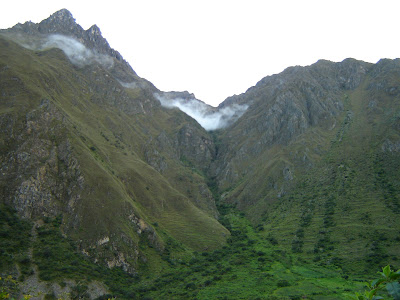
At 05:45 the next morning our group of eight assembled at the Plaza Regocijo to meet our guide and porters. Sleepily bundled into an ancient, but sturdy looking bus we set off on the three-hour drive to Km 82. Just as the bus departed and I closed my eyes, the rain began.Two hours later we stopped for a light breakfast. The mate de coca (coca tea), which accompanied our eggs and bread, soon has our whole group a little less groggy and a lot more excited about the next four days. And what cheered us up even more than the cocaine-infused local tea were the blue skies appearing above us. The mist had lifted and we were able to glimpse the lush green mountains all around us. Perhaps if we had of realized how rare a mist-free morning would be over the next few days we would have taken more photos instead of leisurely enjoying a second (and third) cup of mate de coca.
Another hour on the bus took us to the starting point for the Trail, Km 82. There were quite a few tourist gringos gathered here with their respective tour agencies and I felt like just another tourist. But once we got on our way we soon found the isolation I was hoping for. And the once again present mist only served to add to the mysterious atmosphere of the Andean jungle.Our group was great. There were three couples, from Ireland, New Zealand and Germany as well as one Australian and myself. And, as all of us were experienced hikers we soon made good time and found ourselves a good way from the other groups. Our Peruvian guide, Carlos, assured us that we were the fastest group he’d had in years, although he may have just been flattering us in hope of a good tip.
Day was is labeled the ‘easy’ day on our course maps. We covered a mere fourteen kilometers in six hours. Starting at 2380M and slowing rising to about 3000M by late afternoon. Despite the early rise the mornings hike wasn’t too strenuous. When we stopped for lunch we were all quite amazed to see that our porters had ran ahead of us with two large tents (one for dining and one for cooking), tables, chairs and other unessential, but much appreciated home comforts. As we hung our wet ponchos and hats inside the dining tent to drip dry we were greeted to a three course lunch and more mate de coca to keep our energy up and ward off any altitude sickness. And after an hours break we carried on to our destination for the day, Wyllabamba, supposedly a great place for photos opportunities, but with the surrounding mist we could only see each others faces, smiling at the relief of our first day completed. The rain had temporarily ceased and we took the opportunity to sit around camp and get to know each other. Meanwhile the ever-industrious porters once again began to prepare us a three-course meal for dinner. A healthy fresh vegetable soup to start, followed by four or five dishes for main course, including options for the two vegetarians in the group and, of course, desert to follow. It certainly beat the baked beans, half-cooked sausages and stale bread of my previous camping trips. In the evening we sat in our dining tent sharing stories and telling jokes. A great bunch of people who, between the lot of them have probably been to nearly all the countries in the world, especially the German couple, Katrin and Daniel, who were on a six-month, round the world honeymoon.
The whole group retired to their sleeping tents early in preparation for a 05:30 rise, but I felt I deserved a little reward so retrieved the bottle of whisky from my backpack. An hour or two later I felt I had really bonded with the porters and guide as we shared my ‘water of life’ and tried to communicate in (my terrible) Spanish. So with a slur I said ‘Buenas noches’ and staggered back to my tent with no comprehension of just how few hours I would be allowed to sleep.
At the ungodly hour of five our porters gently awaked us. The absurdities I was about to direct at the man knocking on our tent were soon muted when I seen the two steaming cups of mate de coca he had brought for me and my tent mate Aussie Josh. And next to the tents ha had also placed two plastic basins of warm water for us to wash our faces and armpits, etc.
As I groggily staggered to the dining tent for breakfast, our guide, who had drunken as much as me, energetically asked ‘Ready for the Challenge day Mark?’ I grunted something that even I didn’t understand and took out my Inka Trek map to study our itinerary over a strong cup of coffee. ‘Oh no!’, I thought. This day was going to be a nightmare. Only twelve kilometers over seven hours, but most of it was on a steep incline. We were to start in forest microclimate and then climb up and over the infamous Dead Woman’s Pass where we would reach a height of 4215M, 500M higher than Mt. Fuji. This section was notoriously difficult and the most likely point to suffer altitude sickness, so I began to question the logic of my great whiskey idea the previous evening.
But the coffee and even more mate de coca saved the day and it wasn’t as bad as I expected. Two of our group had fallen sick due to the altitude so our pace was very manageable and the mist even cleared a couple of times to give us the majestic views we were hoping for. Following another great dinner I promptly collapsed in my tent.
Day three was labeled ‘unforgettable’ because of the viewpoints along the way. We seen very little of these because of the mist, but it was still a beautiful six hours hiking, and even more beautiful as it was mostly downhill. Unfortunately the last section involved a steep decline of nearly one thousand metres. The only word I can use to describe this experience is ‘grueling’. My knees and thighs were screaming at me ever step of the way. But at our camp for the night, Winaywayna (something of a base camp), there was a little ‘bar’ and since it was our last night together a few of us had some beers to ease the pain. There was also a little ceremony whereby we thanked our porters for their inhuman strength and speed in carrying all our stuff and food and for preparing such great meals. And then it was off to bed for a super early rise at 04:00.The next morning, miserable and shivering I got out of my sleeping bag in the early morning darkness. We had seven kilometers to cover in two hours to catch sunrise at The Gate of The Sun, the entrance to Machu Picchu. None of us looked too happy to be finally reaching our goal, but just as the sun arose the mist lifted and began to reveal our first sunny day of the trip.


Friday, January 18, 2008

VALLE DE LA LUNA

The Valle de la Luna (Valley of the Moon) is located in the Atacama Desert here in northern Chile. It is named so because it looks like the surface of the moon, with it’s salt lakes, unusual colors and strangely textured rocks. In fact the aridity and surface so much resemble the moon, this is where they tested the Mars Rover.Not content with the punishment dished out to us in Death Valley, Diarmeud and myself shook off another morning’s hangover and rented mountain bikes again. The map said it was sixteen kilometers to the valley. About half was paved and the wind was in our face all the way. So there was definitely an hour of cursing and regretting our decision to once again snub the comfortable tours going to the exact same place for only a few pesos more than the price of bike rental.But as soon as we entered the valley, with not a single person or manmade thing in our sight (except the dirt road), we were very glad of our choice and hard work. Half way through the valley we came across a car, which had got bogged down in the sand. A young Latino couple had mistakenly tried to park in the soft salty sand. So we parked up the bikes with the optimistic idea of helping them push it out. With sleeves rolled up and some rocks jammed under the wheels, we were all ready to truly embarrass ourselves with efforts of strength that we just didn’t have. But as fate or luck would have it, just before we got stuck in, a bus full of Bolivian tourists passed by.This big group of cool young people were in town to perform traditional dances for the tourists an with their fitness and high altitude conditioning they were more than capable of adding enough muscle to ours and successfully getting the car back onto the road. It was really good craic all working together and cheers went up at our success. Then they all got their cameras out and took group photos. A couple of the pretty girls even asked myself and Diarmuid (red-faced and sweaty) if they could take pictures with us. We couldn’t believe it and vowed to definitely go to Bolivia someday where our good looks will finally be recognized and we will have the fame we deserve.Following this we carried on along our rugged path and were in constant awes of the place. I have heard that sunsets are spectacular and full moon walks really eerie, but unfortunately time constraints didn’t allow either. But it was definitely a very special place that I’ll always remember.

Below: Diarmuid enjoying desert life (the frosty looking white on the sand is actually salt)